


Pro Kabaddi League betting centers on match winners, handicaps, total points, and selected player markets. Indian readers usually track team form, raid efficiency, tackle success, and squad news before making a decision.
PKL attracts betting interest because scoring swings are frequent and match tempo changes quickly. That makes pre-match analysis useful and live odds movement important.
Pro Kabaddi League Matches – Schedule, Odds, and Pre-Match Context
PKL betting starts with schedule awareness and market timing. Early odds reflect broad expectations. Later prices react to lineup news, rest periods, injuries, and recent form.
Readers following kabaddi odds usually focus on three things. They check match timing in IST, compare the available main markets, and identify whether the line still matches current team conditions.
Upcoming PKL Matches Schedule
A useful schedule block should include date, IST time, teams, market status, and core odds. For kabaddi, even small roster updates can shift pre-match pricing.
| Date | Time (IST) | Match | Status | Main Market Focus |
| Example | 20:00 | Team A vs Team B | Pre-match | Match winner, handicap, total |
| Example | 21:00 | Team C vs Team D | Live | Winner, live total, next phase |
This format helps readers scan the board quickly. It also separates pre-match planning from live decision-making.

Live and Pre-Match Odds for PKL Games
Pre-match odds are based on broader expectation. Live odds react to the score, empty raids, successful tackles, super tackles, and momentum changes.
The main variables affecting kabaddi prices are:
- recent win and loss sequence
- raid conversion rate
- tackle efficiency
- availability of key raiders or defenders
- bench depth
- short rest between matches
A comparison table keeps the analysis readable:
| Market | What it measures | Typical use |
| Match winner | Who wins the game | Basic pre-match and live selection |
| Handicap | Margin-based expectation | Useful in uneven matchups |
| Total points | Combined scoring output | Useful when tempo is predictable |
| Team total | One side’s scoring | Useful with stable offensive trends |
| Player props | Individual output | Useful for star raiders |


How to Read a PKL Betting Board
- Check the match start time in IST.
- Review recent form for both teams.
- Compare winner, handicap, and total markets.
- Look for lineup or injury updates.
- Reassess when live odds move sharply.
- Avoid staking based on one scoring burst.
A structured reading method reduces impulsive decisions. It also makes kabaddi analysis more consistent across the season.
Kabaddi Betting Markets and Bet Types
Kabaddi markets are narrower than cricket or football, but they are still varied. The core options usually cover winner, spread-style lines, total points, and selected player performance markets.
New readers should start with simple markets. Experienced readers may add live positions or combination tickets after they understand pace, matchup style, and volatility.
Main Kabaddi Betting Markets
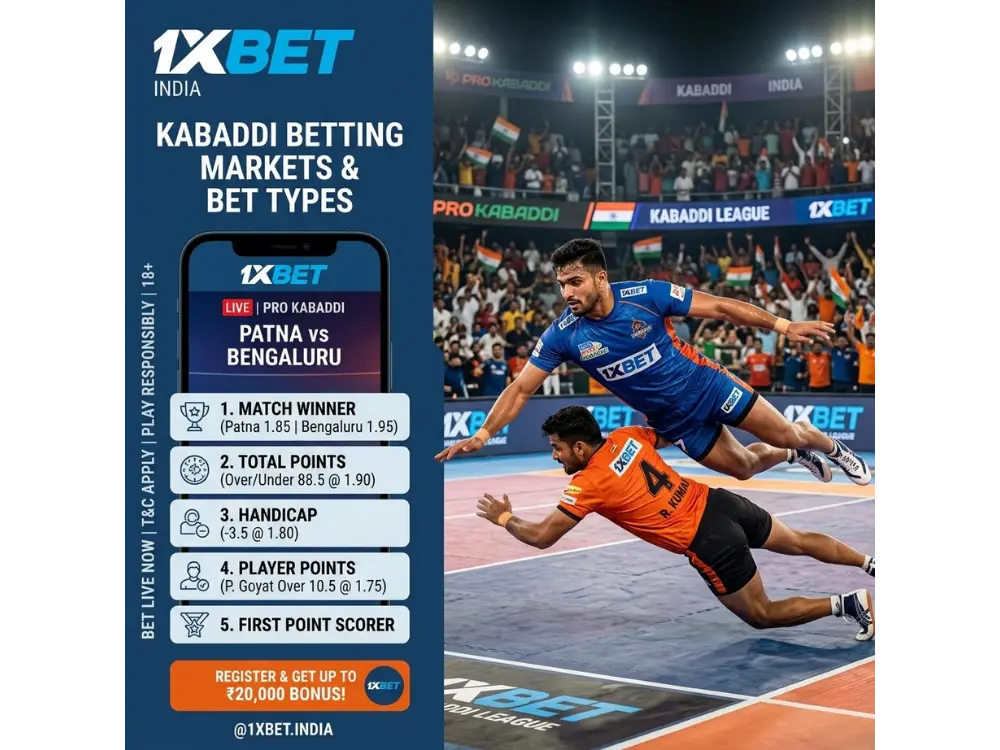
The most common kabaddi markets are:
- Match winner – simplest market, based only on final result
- Handicap – adjusts the stronger or weaker side by points
- Total points – focuses on combined scoring output
- Team total – tracks one team’s points only
- Player performance – may cover raid points or defensive output
| Market | Complexity | Risk profile | Best suited for |
| Match winner | Low | Moderate | Beginners |
| Handicap | Medium | Moderate to high | Readers comparing team strength |
| Total points | Medium | Moderate | Readers focused on pace |
| Team total | Medium | Moderate | Readers tracking one side closely |
| Player props | High | High | Readers using player data |
Popular Bet Types: Pre-Match, Live, and Combinations
Pre-match betting suits readers who prefer preparation over reaction. It allows more time to compare numbers and study form.
Live betting suits fast readers of momentum. It is more volatile because prices change quickly after key raids or defensive plays.
Common ticket types include:
- single bets
- accumulator bets
- system bets
- live bets
A practical approach is to start with singles. Combination tickets increase variance and require stronger price discipline.
Kabaddi-Specific Features and Practical Notes
Kabaddi differs from many field sports because momentum can reverse in a few possessions. Empty raids, do-or-die raids, and super tackles can change both score and market shape fast.
Important match features include:
- do-or-die raid pressure
- foul risk
- tactical time-outs
- medical stoppages
- end-game defensive conservatism
- pace change after a large lead
These features matter because market prices are often tied to rhythm. When rhythm breaks, totals and side prices can move quickly.
Kabaddi Predictions and Match Analysis Framework
Predictions in PKL should be built from evidence, not from team reputation alone. A sound framework uses current form, opponent profile, scoring pattern, and squad condition.
A useful kabaddi prediction model weighs both attack and defense. Strong raiding can be neutralized by disciplined corner defense. High scoring in one match does not guarantee a similar total in the next.
Match Prediction Framework for Upcoming PKL Games
A practical prediction sheet should include:
- last 5 match results
- average raid points scored
- average tackle points scored
- points allowed
- head-to-head context
- workload and rest gap
- key player availability

| Match | Main angle | Safer market type | Key reason |
| Team A vs Team B | Side | Match winner | Better recent balance |
| Team C vs Team D | Total | Under or over | Tempo pattern |
| Team E vs Team F | Player angle | Player prop | Stable individual role |
Predictions become stronger when the market angle matches the evidence. A side bet should come from team strength. A totals bet should come from pace and efficiency.
Proven Analytical Strategies for PKL
- Use closing-line comparison to check whether your read matched the market.
- Keep a fixed bankroll percentage for each wager.
- Separate pre-match records from live records.
- Avoid chasing after a single bad result.
- Focus on 1 or 2 markets you understand well.
- Track team tempo and defensive consistency.
- Recheck assumptions after roster news.
These are analysis habits, not guarantees. Their value lies in discipline, not in certainty.


Advanced Tips to Reduce Mistakes
Watch for inflated reactions after early scoring bursts. One fast sequence can distort live pricing.
Do not overvalue brand-name players when the matchup is poor. Corner defense and support structure often matter as much as star power.
Record every wager with market type, price, and reason. Review losing bets for process errors, not just outcomes.
Responsible betting matters in every format. Set a limit before the match starts and stop when the limit is reached.
Conclusion
PKL betting becomes easier to read when the process stays simple. Start with schedules, match context, core markets, and disciplined stake sizing. Focus on winner, handicap, and total points before adding player props or live positions. Use form, pace, defensive output, and roster news as the main filters. Good kabaddi analysis is built on repeatable checks, not on instinct alone. That approach gives readers a clearer way to evaluate PKL matches and avoid avoidable mistakes.